Best Online Trading for Beginners in the United Kingdom
This online trading for beginners guide gives new UK traders a clear starting point, walking you through how to trade online for beginners, how to buy and sell stocks and how to build a solid portfolio.
This online trading for beginners guide will give you a starting point and guide you through the various processes involved in trading online. Investing on the stock market in the UK can grow your wealth, and stock trading for beginners has become easier than ever in 2026. Online trading is a good online business for beginners. This guide to online trading for beginners UK will give beginners a useful starting point. You will learn how to stock trade for beginners, how to buy and sell stocks and how to trade online for beginners.
How to Trade Online for Beginners in the UK
Want to build a successful portfolio that allows you to prosper and evade the stress that comes with stock trading? This best online trading for beginners UK guide will help you build a solid portfolio. Our online stock brokers allow trading beginners to invest from as little as £100. You can use the money to buy the shares you have chosen from a wide range of selected stocks from the London Stock Exchange (LSE) top companies.
Online Trading UK stock trading experts advise online trading beginners to consider the following potential outcomes of any trade: a small gain, a large gain, breakeven, a small loss, or a large loss. Our stock trading for beginners experts also advise beginner traders to avoid the big loss outcome, which can ruin their entire portfolio. One of the ways to avoid a big loss is by using a stop-loss order. When a trade does not favour you, a stop-loss order exits your trade if the price drops to a certain level.
Definition
Stop-Loss Order
A stop-loss order is a risk management instruction that automatically closes your trade once the price falls to a level you set in advance, helping beginners limit their losses on a losing position.
Although investing in stocks for the long term is one of the solid ways to create wealth, investments also come with risks. As an online trading beginner, it is very important that you try by all means to minimise the risks. That is where online trading platforms for beginners UK come in. These platforms provide easy registration, education, tutorials for beginners and professional advice.
Online Trading for Beginners in 6 Steps
Follow these six beginner steps to start online trading in the UK the right way. Each step builds on the last to help you trade with a clear plan.
1. Open a Stock Trading Account
Get started by registering for the best online stock trading platform for beginners UK using your PC or smartphone. The process is very easy: sign up using your email address, enter your personal details, provide the required documents and read the terms and conditions.
2. State Your Own Investment Goals
Are your goals to trade until retirement, or are you investing so your children will have a better future? Defining your investment goals will help you determine how long your investment plan will be, and what kind of investments you want to hold.
3. Decide How Much You Want to Invest
Your financial situation will determine the overall amount you invest in stocks. It is advisable that when you are starting online trading for beginners, you do not borrow money to invest, as loans come with interest. Save up and start building your portfolio by investing little by little.
4. Educate Yourself
Education is one of the most important factors. Before investing, learn how to stock trade for beginners and how to trade on the LSE. There are many videos and books on online trading for beginners in the UK that simplify investment terminology. Best online trading platforms for beginners offer free courses, educational materials and seminars. Never invest in anything you do not understand.
5. Describe How You Want to Invest
Do not invest money you cannot afford to lose. As a beginner there are many risks involved and you should leave room for learning. Align your investment goals with your chosen method. Common share types include income shares (which pay dividends), growth shares (expected to grow faster than the market average) and blue-chip shares (large, well-known companies with long track records).
6. Find an Online Broker
The final step is choosing a broker. A broker administers your share purchases by placing orders. In the UK you can use a full-service broker or trade yourself by signing up with one of our recommended FCA regulated brokers above.
Types of Shares Beginners Should Know
Definition
Income Shares
Income shares are a class of shares offered by a dual-purpose fund that pays out distributions and dividends to its investors, ideal for those seeking regular income.
Definition
Growth Shares
Growth shares are shares in a company that are anticipated to grow at a rate significantly above the average for the market, favoured by investors chasing capital gains.
Definition
Blue-Chip Shares
Blue-chip shares are shares in large multinational corporations with well-known names and long track records of growth and dividend payments, often seen as more stable.
Top Online Trading Tips for Beginners
Always practise on a demo account before using real money
Only invest money you can afford to lose
Use stop-loss orders to protect your portfolio
Diversify across sectors to reduce risk
Keep learning with courses, webinars and books
Never trade based on emotions or hype
Start small and scale up as you gain experience
Choose an FCA regulated broker you can trust
Some brokers also offer downloadable Online Trading Tips for Beginners PDF guides and Online Trading Courses for Beginners in the United Kingdom. You can also open a demo account to practise how to buy and sell stocks before going live. When you are ready, compare our recommended online trading platforms and forex brokers UK.
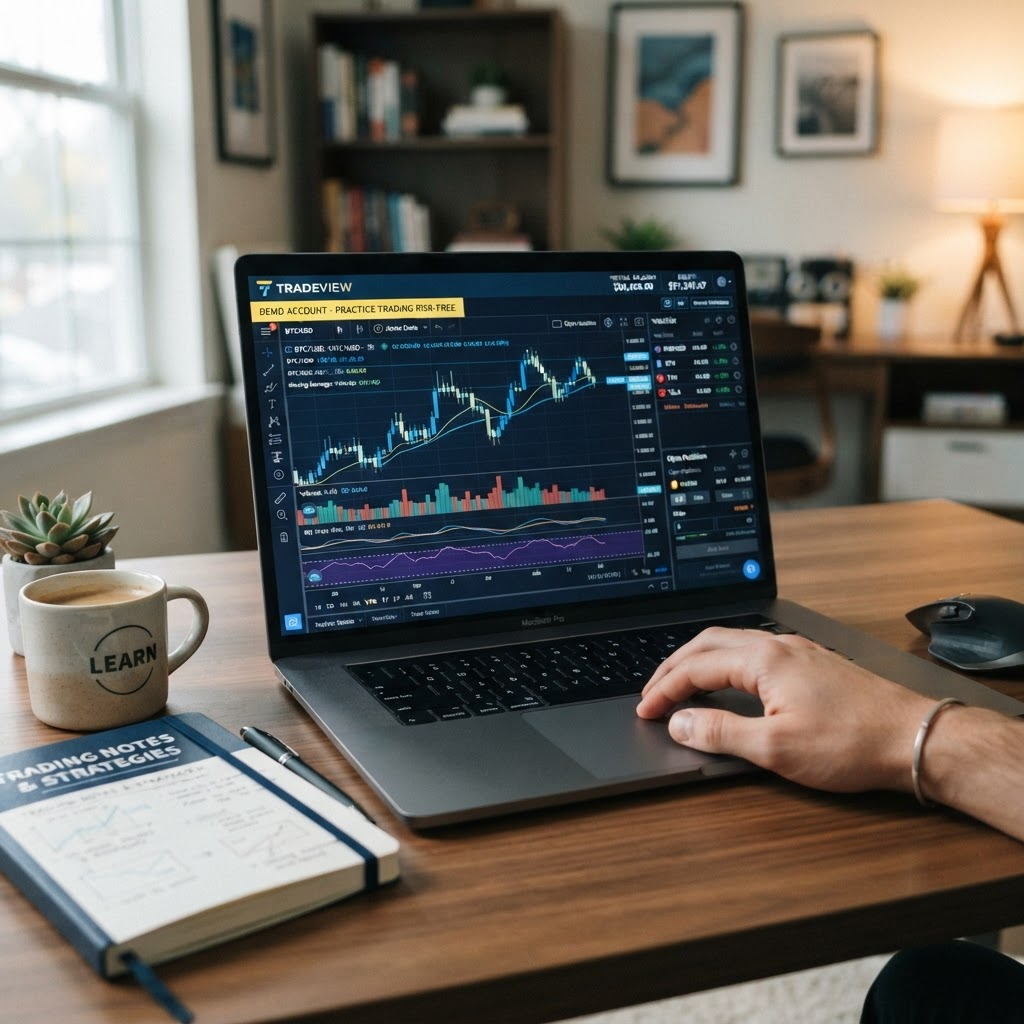
Practising on a demo account helps beginners learn before risking real money.
What Is Online Trading? A Beginner's Explanation
Before you place your first trade, it helps to understand exactly what online trading is in plain English. Online trading simply means buying and selling financial instruments such as shares, currencies, commodities and CFDs over the internet using a regulated broker or trading platform. In the past, you had to phone a stockbroker to place a trade. Today, as a beginner in the UK, you can open an account, deposit money and buy or sell in seconds from your phone or laptop.
Definition
Online Trading (for Beginners)
Online trading is the process of using an internet-based platform to buy and sell financial assets like shares and forex, aiming to profit from changes in their price. For beginners, it is best thought of as a skill that must be learned gradually rather than a way to get rich quickly.
The key thing for beginners to remember is that online trading is a skill. Just like driving or learning a language, it takes time, practice and patience to become good at it. Nobody becomes a profitable trader overnight, and anyone who promises guaranteed profits is not being honest with you. Approach trading with realistic expectations, a willingness to learn and a healthy respect for risk, and you will give yourself the best chance of long-term success.
Why Online Trading Is So Popular With UK Beginners
Online trading has exploded in popularity among UK beginners over the past few years, and there are several good reasons for this. Understanding why so many people are getting started can help you approach trading with the right mindset.
Low starting costs - many brokers accept deposits from around £50
Commission-free share trading on many UK platforms
Easy-to-use mobile apps you can trade from anywhere
Free demo accounts to practise without risk
Access to global markets from a single account
Huge amounts of free educational material online
FCA regulation that protects UK retail traders
The potential to build long-term wealth over time
That said, popularity does not mean trading is easy or risk-free. The same features that make online trading accessible, such as leverage and instant execution, can also lead beginners into trouble if they are not careful. This is why education and risk management, covered later in this guide, matter so much for new traders in the United Kingdom.
Trading vs Investing: Which Should Beginners Choose?
One of the first decisions a beginner needs to make is whether they want to trade or invest. Although the words are often used to mean the same thing, they describe two different approaches, and understanding the difference will help you choose the right account and strategy.
Investing is a long-term approach where you buy shares, funds or ETFs and hold them for years, aiming to grow your wealth steadily through rising prices and reinvested dividends. It is generally lower risk, requires less time and is well suited to beginners who want to build wealth gradually, often inside a tax-efficient Stocks and Shares ISA.
Trading is a shorter-term, more active approach where you buy and sell more frequently to profit from price movements, often using leveraged products such as CFDs and forex. Trading can be more rewarding for skilled traders but is significantly riskier, which is why most retail CFD accounts lose money. Many beginners start by investing for the long term while learning to trade on a demo account before risking real money on short-term trades.
Essential Trading Terms Every Beginner Should Know
Trading has its own language, and beginners can quickly feel overwhelmed by jargon. Learning these essential terms early will help you understand market commentary, use your platform confidently and avoid costly misunderstandings.
Definition
Spread
The spread is the small difference between the buy (ask) price and the sell (bid) price of an asset. It is one of the main ways brokers make money, and tighter spreads mean lower trading costs for you.
Definition
Leverage
Leverage lets you control a larger position than your deposit by effectively borrowing from your broker. It magnifies both profits and losses, so beginners should use it very cautiously or avoid it altogether.
Definition
Margin
Margin is the amount of money you need to put down to open a leveraged position. If the market moves against you, you may receive a margin call asking you to add more funds.
Definition
Dividend
A dividend is a share of a company's profits paid out to shareholders, usually twice a year. Reinvesting dividends is a powerful way to grow long-term returns.
Definition
Portfolio
Your portfolio is the complete collection of investments and trades you hold. Diversifying your portfolio across different assets and sectors helps to reduce risk.
Definition
Volatility
Volatility measures how much and how quickly a price moves. Highly volatile markets offer bigger opportunities but also carry greater risk, which beginners should respect.
How Much Money Do Beginners Need to Start Trading?
A question almost every beginner asks is how much money they need to start online trading in the UK. The good news is that you can start with very little. Several of the FCA regulated brokers featured on this website accept minimum deposits of around £50, and some allow you to open an account with even less. You do not need thousands of pounds to begin.
However, how much you should start with is a different question from how much you can start with. As a beginner, the goal in your first few months is not to make money but to learn without losing much. For that reason, we recommend starting with a small amount you are completely comfortable losing, and only increasing your capital once you have proven you can trade profitably and manage risk consistently. Never borrow money to trade, and never use funds needed for rent, bills or emergencies.
Remember that trading costs eat into small accounts more heavily in percentage terms, so keep an eye on spreads, commissions and any inactivity or withdrawal fees. Starting small and scaling up gradually is the sensible, sustainable path for every beginner.
How Beginners Should Choose Their First Broker
Choosing your first broker is a big decision, but it does not need to be complicated. As a beginner, focus on safety, ease of use and support rather than advanced features you will not use yet. Use the checklist below when comparing the brokers in our table above.
FCA regulated so your money is protected
A free demo account to practise on
A low minimum deposit to start small
A simple, beginner-friendly platform and app
Clear, transparent fees with no nasty surprises
Good educational resources and tutorials
Responsive customer support via chat, email or phone
Built-in risk tools like stop-loss and take-profit orders
Do not feel you have to commit to one broker forever. Many UK beginners open demo accounts with two or three brokers to compare their platforms before choosing where to trade with real money. Take your time, read our trading platform reviews and pick the broker that feels easiest and safest for you.
Understanding Order Types as a Beginner
When you place a trade, you need to tell your platform exactly how you want it executed. These order types are the basic tools every beginner must understand before trading with real money.
Definition
Market Order
A market order buys or sells immediately at the best available price. It guarantees your trade is executed but not the exact price you get, which matters in fast-moving markets.
Definition
Limit Order
A limit order only executes at a price you specify or better. It gives you control over your entry or exit price but does not guarantee the trade will be filled.
Definition
Stop-Loss Order
A stop-loss order automatically closes your trade if the price moves against you to a set level, capping your loss. This is the single most important risk tool for beginners.
Definition
Take-Profit Order
A take-profit order automatically closes your trade once it reaches a target profit, helping you lock in gains without having to watch the market constantly.
Risk Management for Beginner Traders
If there is one section of this guide you should read twice, it is this one. Risk management is what separates traders who last from those who blow up their accounts in the first few months. As a beginner, protecting your capital must always come before chasing profits.
The golden rule is to never risk more than 1-2% of your total account on a single trade. This means that even a long losing streak will not wipe you out, giving you time to learn and improve. Always use a stop-loss order so you know your maximum loss before you enter a trade, and set a take-profit target so you have a clear plan for both outcomes.
Avoid the temptation to over-leverage. Leverage can turn a small deposit into large exposure, but it magnifies losses just as much as gains and is a common reason beginners lose money quickly. Diversify across different assets rather than putting everything into one trade, and never chase losses by doubling down after a bad trade. Discipline and patience are your greatest assets as a new trader.
How to Build Your First Trading Plan
Professional traders never trade without a plan, and neither should you. A trading plan is a simple written document that sets out your goals, your rules and your risk limits. Having one removes emotion from your decisions and keeps you consistent. Your beginner trading plan should answer these questions.
What are my financial goals and time horizon?
How much money am I prepared to risk in total?
Which markets and assets will I trade?
How much will I risk per trade (1-2%)?
What is my strategy for entering trades?
Where will I place my stop-loss and take-profit?
How many trades will I make per day or week?
How will I review and learn from my results?
Write your plan down and stick to it. Review it regularly using a trading journal where you record every trade, the reason you took it and the outcome. Over time, this journal becomes the most valuable learning tool you have, revealing your strengths, weaknesses and the patterns that lead to your best and worst results.
Moving From a Demo Account to Live Trading
Every beginner should start on a demo account, but at some point you will want to make the leap to trading with real money. This transition is a bigger psychological step than most people expect, because real money brings real emotions. Trading virtual funds is easy to stay calm about, but watching your own money rise and fall triggers fear and greed that can lead to poor decisions.
To make the transition smoothly, only move to live trading once you have been consistently profitable on your demo account for at least a few weeks. Start with the smallest position sizes possible and the minimum deposit you are comfortable with. Treat your early live trades as continued education rather than a chance to make big money. Expect to make mistakes, keep your risk tiny, and scale up only as your confidence and consistency grow.
Common Mistakes Beginner Traders Make
Learning from other people's mistakes is far cheaper than making them yourself. These are the most common errors that catch out beginner traders in the UK, and every one of them is avoidable with discipline and preparation.
Skipping the demo account and going straight to live
Risking too much on a single trade
Trading without a plan or strategy
Not using stop-loss orders
Over-leveraging small accounts
Chasing losses with revenge trades
Letting emotions like fear and greed take over
Investing in things they do not understand
If you can avoid these mistakes, you will already be ahead of the majority of beginners. Combine that discipline with ongoing education and sensible risk management, and you give yourself a genuine chance of becoming a consistent, confident trader over time.
Understanding the Stock Market for Beginners
To trade shares with confidence, beginners should understand how the stock market actually works. A stock market, or stock exchange, is a regulated marketplace where buyers and sellers come together to trade shares in publicly listed companies. In the United Kingdom, the main exchange is the London Stock Exchange (LSE), one of the oldest and most respected exchanges in the world.
When a company wants to raise money, it can sell shares to the public through an Initial Public Offering (IPO). Once those shares are listed, they can be freely bought and sold by investors and traders. The price of a share moves up and down based on supply and demand, which in turn is driven by the company's performance, economic conditions, interest rates and market sentiment.
Definition
FTSE 100
The FTSE 100 is an index of the 100 largest companies listed on the London Stock Exchange by market capitalisation. It is widely used as a barometer of the health of the UK stock market and the wider economy.
As a beginner, you do not need to understand every detail of market mechanics, but knowing that share prices reflect real businesses and real economic forces will help you make more rational decisions. When you buy a share, you are buying a small piece of a real company, not just a number on a screen.
How to Read a Price Chart as a Beginner
Price charts are the trader's most important visual tool, and learning to read them is a core beginner skill. The most popular chart type is the candlestick chart, which packs a lot of information into a simple visual format. Each candlestick shows the opening price, closing price, high and low for a given period of time.
Definition
Candlestick Chart
A candlestick chart displays price movements using candles, where the body shows the open and close and the wicks show the high and low. Green (or white) candles usually mean the price rose, while red (or black) candles mean it fell.
Beginners should also learn about support and resistance. Support is a price level where buying tends to stop a price from falling further, while resistance is a level where selling tends to stop a price from rising. These levels help traders decide where to enter, exit and place stop-loss orders. You do not need to master advanced technical analysis straight away, but understanding candlesticks, trends, support and resistance gives you a solid foundation.
How to Research a Stock Before You Buy
One of the biggest mistakes beginners make is buying a share simply because they have heard the name or seen it mentioned on social media. Before you invest in any company, take the time to do some basic research. This does not need to be complicated, but it should be thorough enough to give you confidence in your decision.
Does the company make a profit and is it growing?
How much debt does the company carry?
Does it pay a dividend, and is that dividend sustainable?
How does its Price-to-Earnings (P/E) ratio compare to peers?
What are the risks facing the company and its sector?
Is the wider industry growing or shrinking?
What do recent company results and news say?
Is the current share price reasonable value?
Good online trading platforms provide research tools, company financials, analyst ratings and news feeds to help beginners with this process. Combining fundamental research about the business with basic chart analysis gives you the fullest possible picture before you commit your money.
Understanding Trading Fees and Costs
Fees might seem small, but over time they have a big impact on a beginner's returns, especially on a small account. Understanding what you are being charged helps you keep more of your profits. The main costs beginners should watch out for are listed below.
Definition
Commission
Commission is a fee some brokers charge each time you buy or sell shares. Many UK platforms now offer commission-free share trading, but always check before you assume it is free.
Definition
Spread
The spread is the difference between the buy and sell price and is a cost you pay on every trade. Tighter spreads mean lower costs, which is particularly important for frequent traders.
Definition
Overnight Fee
Also called a swap fee, this is charged for holding leveraged positions such as CFDs overnight. It can add up quickly, so it matters most to short-term leveraged traders.
Beginners should also watch for inactivity fees, withdrawal fees, currency conversion charges and any monthly platform fees. Read the full fee schedule of any broker before you open an account, and factor these costs into your trading plan.
Trading Psychology for Beginners
Many beginners are surprised to learn that trading success depends as much on mindset as on strategy. The two emotions that damage trading accounts most are fear and greed. Fear can cause you to sell winners too early or freeze when you should act, while greed can push you to take reckless risks, over-trade or hold onto losers hoping they recover.
The best way for beginners to master their emotions is to have a written trading plan and follow it strictly, so decisions are based on rules rather than feelings. Keeping your position sizes small also keeps your emotions in check, because you are never risking an amount that would hurt. Accept that losses are a normal and unavoidable part of trading; even the best traders lose on many trades. What matters is that your winners are bigger than your losers over time, and that you never let one bad trade spiral into an emotional decision.
Tax-Efficient Trading With ISAs for Beginners
UK beginners have access to one of the most valuable tools in investing: the Stocks and Shares ISA. An ISA (Individual Savings Account) lets you invest up to an annual allowance each tax year, and any profits, dividends or interest you earn inside it are completely free from UK Capital Gains Tax and Dividend Tax.
For beginners focused on long-term investing in shares and funds, using a Stocks and Shares ISA is often a sensible first step because it shelters your gains from tax and simplifies your record-keeping. Active traders using leveraged products like CFDs and forex cannot usually trade those inside an ISA, but they may consider spread betting, which is currently free from Capital Gains Tax for most UK retail traders. Always check the latest rules, as tax treatment depends on your individual circumstances and can change.
How Beginners Can Stay Safe From Trading Scams
Unfortunately, the popularity of online trading has attracted scammers who target beginners. Protecting yourself is simple if you know what to look for. The single most important rule is to only ever trade with a broker that is authorised and regulated by the Financial Conduct Authority (FCA). You can check a firm's status on the FCA register for free.
Only use FCA regulated brokers you can verify
Be sceptical of guaranteed profits or get-rich-quick claims
Never share your login or banking details with anyone
Avoid unsolicited investment offers on social media
Do not let anyone manage your account for you remotely
Watch out for fake celebrity endorsements
Never send money to recover previous losses
If it sounds too good to be true, it is
A legitimate, FCA regulated broker will never pressure you, guarantee returns or ask for remote access to your device. Taking a few minutes to verify a broker before depositing could save you from losing everything to a scam.
Setting Realistic Expectations as a New Trader
Perhaps the most important lesson for any beginner is to set realistic expectations. Social media is full of people claiming to make life-changing money overnight, but the reality is very different. The vast majority of new traders lose money in their first year, and most retail CFD accounts lose money overall. This is not meant to discourage you, but to help you approach trading sensibly.
Think of your first six to twelve months as a training period. Your goal is to learn the platform, develop a strategy, practise risk management and build good habits, not to get rich. If you can protect your capital and learn steadily, you put yourself in a tiny minority of beginners who give themselves a genuine chance of long-term success. Trading rewards patience, discipline and continuous learning far more than it rewards luck or impatience.
Which Trading Style Suits a Beginner?
As you learn, you will discover that there are several different trading styles, each suited to different personalities, schedules and risk appetites. Choosing a style that fits your life is important, because trying to day trade when you have a full-time job, for example, is a recipe for stress and mistakes.
Long-Term Investing
This is the lowest-stress approach and often the best starting point for beginners. You buy quality shares or funds and hold them for years, ignoring short-term noise. It requires little time and benefits from compounding and reinvested dividends.
Swing Trading
Swing traders hold positions for several days or weeks. This suits beginners with a job because you can analyse the markets in the evening rather than watching them all day. It relies mainly on chart analysis and identifying trends.
Day Trading
Day traders open and close all positions within the same day. It is fast-paced, time-consuming and high-risk, so it is generally not recommended for beginners until they have significant experience and a proven strategy.
Most beginners are best served by starting with long-term investing or swing trading on a demo account, then deciding which approach fits their temperament before considering faster, riskier styles.
The Power of Compounding for Beginners
One of the most powerful concepts in investing is compounding, and beginners who understand it early gain a huge advantage. Compounding is the process of earning returns not just on your original investment, but also on the returns you have already made. Over time, this snowball effect can turn modest, regular investments into significant sums.
Definition
Compounding
Compounding is when the returns you earn are reinvested and go on to generate their own returns. The longer your money is invested, the more powerful the compounding effect becomes, which is why starting early matters so much.
For example, reinvesting dividends rather than spending them allows you to buy more shares, which then pay more dividends, which buy even more shares. This is why patient, long-term investors often build far more wealth than impatient short-term traders. Time in the market, combined with consistent contributions, is one of the most reliable paths to building wealth for UK beginners.
Building Good Trading Habits From Day One
The habits you build as a beginner will shape your entire trading journey. Good habits formed early are hard to break, while bad habits can be very costly. Here are the habits every successful trader develops, and which you should start practising from your very first demo trade.
Always trade with a written plan
Record every trade in a journal
Use a stop-loss on every single position
Review your performance weekly
Keep learning and reading about the markets
Stay calm and never trade on emotion
Take breaks and avoid screen fatigue
Celebrate discipline, not just profits
Consistency is the hallmark of a good trader. By building these habits while you are still practising on a demo account, they will feel natural by the time you trade with real money. Explore our best trading apps guide to find a platform that makes journaling and reviewing your trades easy.
Funding Your First Trading Account
Once you have chosen a broker and completed the sign-up and verification process, the next step is funding your account. UK brokers make this straightforward, but beginners should understand their options and any associated costs before depositing. Most platforms accept debit cards, bank transfers via Faster Payments and popular e-wallets such as PayPal, Skrill and Neteller.
We strongly recommend that beginners start with the smallest deposit they are comfortable with. There is no need to fund your account heavily while you are still learning. Choose a broker that offers accounts in pounds sterling to avoid unnecessary currency conversion fees, and always check whether there are any deposit or withdrawal charges. Test the withdrawal process early by taking out a small amount, so you can be confident that accessing your money is quick and hassle-free before you commit more capital.
Why Diversification Matters for Beginners
One of the most valuable lessons a beginner can learn is the importance of diversification. The old saying "don't put all your eggs in one basket" is the essence of this principle. Diversification means spreading your money across different assets, sectors and markets so that a loss in one area does not devastate your entire portfolio.
Definition
Diversification
Diversification is a risk management strategy that mixes a wide variety of investments within a portfolio. Because different assets react differently to the same event, a diversified portfolio tends to produce smoother, less volatile returns over time.
For a beginner, diversification might mean holding shares in several different companies across different industries, rather than putting everything into a single stock. It could also mean spreading money across different asset classes such as shares, funds, commodities and cash. While diversification cannot eliminate risk entirely, it significantly reduces the impact of any single investment going wrong. Exchange-traded funds (ETFs) are a popular way for UK beginners to achieve instant diversification, because a single ETF can give you exposure to hundreds of companies at once.
Continuing Your Trading Education
The best traders never stop learning, and as a beginner your education is only just beginning. The financial markets are constantly evolving, and there is always more to understand about strategy, psychology, risk and analysis. Committing to ongoing learning is one of the surest ways to improve your results over time.
Take advantage of the free educational resources offered by FCA regulated brokers, including webinars, video courses, articles and market analysis. Read books on trading psychology and technical analysis, follow reputable financial news sources, and consider keeping a detailed trading journal that you review regularly. Learn from your losses as much as your wins, because your mistakes often teach you the most valuable lessons.
Above all, be patient with yourself. Becoming a skilled trader takes months and years, not days and weeks. By combining the fundamentals covered in this guide with continuous learning, disciplined risk management and plenty of demo practice, you will steadily build the knowledge and confidence you need. Explore our other guides on forex trading, trading platforms and the complete online trading UK guide to keep progressing on your journey.
Online Trading for Beginners FAQs
How much money do I need to start online trading in the UK?
Many UK online brokers let beginners start from as little as £5 to £100. It is wise to start small, only invest money you can afford to lose and increase your investment gradually as you gain experience.
Is online trading good for beginners?
Online trading can be a good way for beginners to grow wealth, but it carries real risk. Beginners should educate themselves, practise on a demo account and use risk management tools such as stop-loss orders before trading with real money.
Should beginners use a demo account first?
Yes. A demo account lets beginners practise buying and selling with virtual money, learn the platform and test strategies without risking real capital. It is one of the best first steps for new UK traders.
What should a beginner avoid when trading online?
Beginners should avoid the big loss outcome that can ruin an entire portfolio. Avoid borrowing money to invest, trading with emotions, overtrading and investing in anything you do not understand.
How long does it take to become a good trader?
There is no fixed timeline, but most beginners need several months of practice, education and demo trading before they become consistent. Trading is a skill that improves with experience, so be patient and treat every trade as a learning opportunity rather than expecting instant profits.
What is the best market for beginners to trade?
Many beginners start with shares or ETFs because they are easier to understand and do not require leverage. Forex and CFDs can offer more opportunities but are riskier and more complex, so they are usually better once you have gained some experience on a demo account.
Do I need to pay tax as a beginner trader in the UK?
You may be liable for Capital Gains Tax on profits above your annual allowance, and Dividend Tax on dividends above the dividend allowance. Trading inside a Stocks and Shares ISA can shelter gains from tax. Always check the latest HMRC rules or speak to a tax adviser.
Can I learn online trading for free?
Yes. Most FCA regulated brokers offer free educational courses, webinars, tutorials and demo accounts. Combined with free guides like this one, you can learn the fundamentals of online trading without spending any money before you start trading for real.
Conclusion
Online trading for beginners in the UK does not have to be intimidating. By opening an account with an FCA regulated broker, setting clear goals, educating yourself and starting small, you can build a solid portfolio while managing risk. Remember that online trading is risky and you can lose money, so always practise first and never invest more than you can afford to lose.
Ready to take the next step? Compare our top beginner-friendly brokers above, then explore our full online trading UK guide for more detail.