Forex Guide 2026

Forex Trading in the UK: The Complete 2026 Guide

Forex is the largest and most liquid financial market in the world, with over $7.5 trillion traded every day. This complete guide explains how forex trading works, the key terms you need to know and how to choose the best FCA regulated forex broker in the UK for 2026.

Forex trader analysing currency charts on a mobile trading app in the UK

Best Forex Brokers UK 2026

1

Plus500

Leading CFD Broker in the UK

4.8out of 5 rating

FCA regulated CFD trading

Min. Deposit
£50
Founded
2008
Platforms
Plus500 WebTrader, App
Regulation
FCA (FRN 509909)
Visit Plus500

Plus500 Authorised and Regulated by the FCA (FRN 509909) in the UK. 76% of retail CFD accounts lose money.

2

XM

Global Multi-Asset Broker

4.7out of 5 rating

Low spreads & fast execution

Min. Deposit
£5
Founded
2009
Platforms
MT4, MT5, XM App
Regulation
FCA, CySEC, ASIC
Visit XM
3

SabioTrade

Leading Prop Trading Firm

4.5out of 5 rating

Trade funded accounts up to $200K

Min. Deposit
From $89 challenge fee
Founded
2021
Platforms
SabioTrade Web & App
Regulation
Prop firm · Ireland
Visit SabioTrade

SabioTrade is a proprietary trading firm, not a CFD/forex broker. You trade the firm’s capital after passing an evaluation and share in the profits.

4

HYCM

Established Broker Since 1977

4.4out of 5 rating

Forex, shares and commodities

Min. Deposit
£20
Founded
1977
Platforms
MT4, MT5
Regulation
FCA, CySEC, DFSA
Visit HYCM
5

Exness

Trusted Low-Spread Broker

4.3out of 5 rating

Instant withdrawals & tight spreads

Min. Deposit
£50
Founded
2008
Platforms
MT4, MT5, Exness Terminal
Regulation
FCA, CySEC, FSCA
Visit Exness

Forex trading — short for foreign exchange trading — is the act of buying one currency while simultaneously selling another, with the aim of profiting from changes in their relative value. It is the backbone of the global economy and, thanks to online trading platforms, it is now accessible to retail traders across the United Kingdom. In this guide we cover everything a UK trader needs to know to get started with forex trading in 2026.

Definition

Forex Trading

Forex (FX) trading is the buying and selling of currencies on the foreign exchange market with the goal of making a profit from fluctuations in exchange rates. Currencies are always traded in pairs — such as GBP/USD — and traders speculate on whether one currency will strengthen or weaken against the other.

How Does Forex Trading Work?

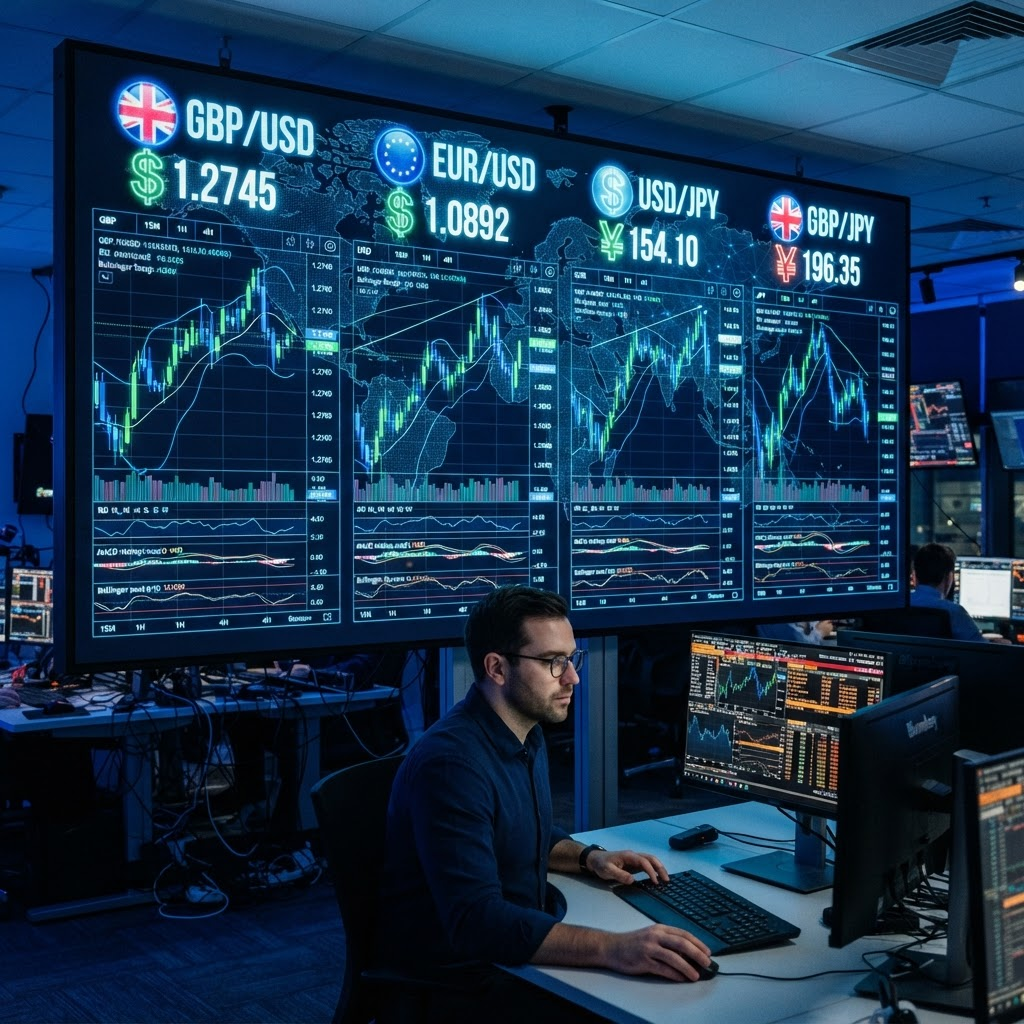
In forex, currencies are quoted in pairs, for example GBP/USD (British pound versus US dollar). The first currency is the base currency and the second is the quote currency. If you believe the pound will strengthen against the dollar, you buy GBP/USD (go long). If you think it will weaken, you sell GBP/USD (go short). Your profit or loss depends on how far the exchange rate moves in your favour or against you.

Most retail forex trading in the UK is done using CFDs (contracts for difference) or spread bets, which allow you to trade with leverage. This means you can control a large position with a relatively small deposit — but it also magnifies both profits and losses.

Forex trading platform showing a GBP currency pair chart with buy and sell buttons
Forex traders speculate on the rising or falling value of currency pairs.

Key Forex Trading Terms Explained

Before you place your first trade, it is essential to understand these core forex terms.

Definition

Currency Pair

A currency pair is the quotation of two different currencies, where the value of one is compared against the other. Examples include GBP/USD, EUR/USD and USD/JPY. Major pairs all include the US dollar.

Definition

Pip

A pip (percentage in point) is the smallest standard unit of price movement in a currency pair, usually the fourth decimal place (0.0001). Profits and losses in forex are often measured in pips.

Definition

Spread

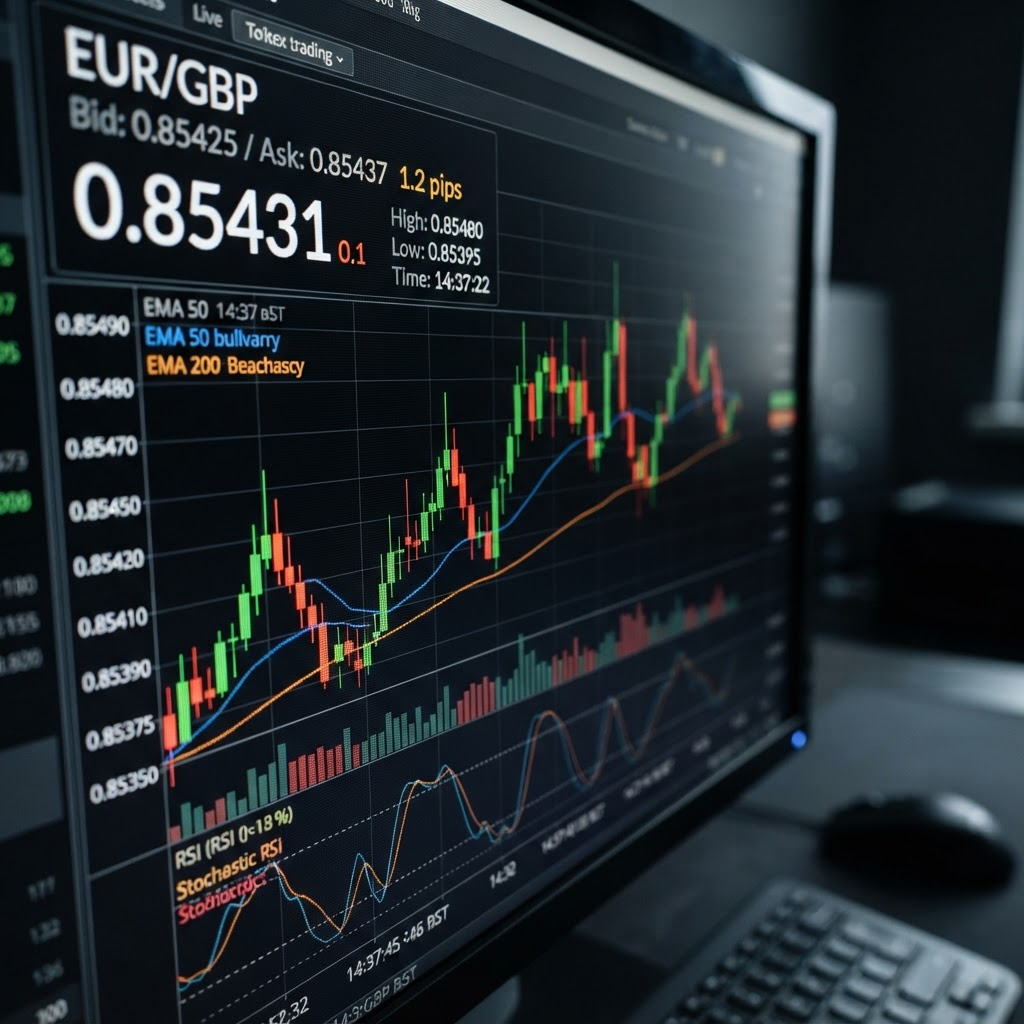
The spread is the difference between the bid (sell) price and the ask (buy) price of a currency pair. It represents the primary cost of trading with most forex brokers.

Definition

Leverage

Leverage allows you to control a large position with a small amount of capital. In the UK, retail forex leverage is capped by the FCA at 30:1 for major currency pairs. Leverage amplifies both gains and losses.

Definition

Lot

A lot is a standardised unit of trade size in forex. A standard lot is 100,000 units of the base currency, while mini (10,000) and micro (1,000) lots let smaller traders manage position sizes.

Forex Trading Key Takeaways

  • Forex is the world's largest market, trading over $7.5 trillion per day
  • Currencies are always traded in pairs, such as GBP/USD
  • UK retail forex leverage is capped at 30:1 by the FCA for major pairs
  • The spread is the main cost of trading forex with most brokers
  • Leverage magnifies both profits and losses — use it carefully
  • The London session offers the most liquidity for UK traders

To trade forex you need an account with a regulated forex broker. The brokers featured above are all FCA regulated or tier-1 regulated and offer competitive spreads, powerful platforms like MetaTrader 4 and MetaTrader 5, and strong support for UK clients. For a deeper comparison, see our dedicated forex brokers page.

The Major Currency Pairs

Forex pairs are grouped into three categories. Understanding them helps you choose which markets to trade.

Major Pairs

The majors all include the US dollar and account for the bulk of global trading volume: EUR/USD, GBP/USD, USD/JPY, USD/CHF, USD/CAD, AUD/USD and NZD/USD. They typically have the tightest spreads and highest liquidity.

Minor Pairs (Crosses)

Minor pairs do not include the US dollar but involve other major currencies, such as EUR/GBP, EUR/JPY and GBP/JPY. Spreads are usually a little wider than the majors.

Exotic Pairs

Exotic pairs pair a major currency with the currency of an emerging economy, such as USD/TRY (Turkish lira) or USD/ZAR (South African rand). They offer big moves but come with wider spreads and higher volatility.

Forex Trading Strategies

Successful forex traders follow a defined strategy rather than trading on impulse. Popular approaches include:

Scalping

Scalpers make many small trades throughout the day, aiming to profit from tiny price movements. This style requires tight spreads, fast execution and intense focus.

Day Trading

Day traders open and close positions within the same trading day, avoiding overnight financing charges and overnight risk. Day trading is popular among active UK forex traders.

Swing Trading

Swing traders hold positions for several days or weeks, aiming to capture larger price swings. This style suits those who cannot watch the markets all day.

Position Trading

Position traders take a long-term view, holding trades for weeks or months based on fundamental analysis of economic trends and central-bank policy.

How to Start Forex Trading in the UK

Getting started with forex trading is straightforward: choose an FCA regulated broker, open and verify your account, practise on a free demo account, fund your account and place your first trade with a clear risk-management plan. For a full step-by-step walkthrough, read our online trading for beginners guide, and download a mobile online trading app to trade on the move.

Why Trade Forex?

Forex has become one of the most popular markets for UK retail traders, and it is worth understanding why so many people are drawn to it. While it carries significant risk, forex offers a number of characteristics that set it apart from other markets and make it particularly appealing to active traders.

  • The market is open 24 hours a day, five days a week
  • Extremely high liquidity, especially on major pairs
  • The ability to profit in both rising and falling markets
  • Low barriers to entry with small minimum deposits
  • Tight spreads on major currency pairs keep costs low
  • A huge choice of FCA regulated brokers and platforms
  • Access to leverage, which can amplify returns (and losses)

These advantages explain why forex is often the first market new traders explore. However, the same features that make forex attractive, particularly leverage and volatility, also make it risky. The key is to approach the market with realistic expectations, a solid education and disciplined risk management from day one.

Fundamental vs Technical Analysis in Forex

Successful forex traders rely on analysis to inform their decisions, and there are two main schools of thought. Most experienced traders use a combination of both to build a complete picture of the market before placing a trade.

Definition

Fundamental Analysis

Fundamental analysis examines the economic, political and social factors that influence a currency's value, such as interest rates, inflation, employment data and central bank policy. It helps traders understand the bigger picture and longer-term trends.

Definition

Technical Analysis

Technical analysis studies historical price charts and patterns to forecast future movements. It uses indicators such as moving averages, RSI and support and resistance levels to identify potential entry and exit points.

Fundamental analysis is especially important in forex because currencies are so heavily influenced by macroeconomic events and central bank decisions. Technical analysis, on the other hand, helps you time your trades and manage risk. Learning to combine the two gives you a significant edge and is a skill that develops over months and years of practice.

What Moves the Forex Market?

Understanding what drives currency prices is fundamental to becoming a successful forex trader. Exchange rates are influenced by a complex mix of factors, and being aware of them will help you anticipate potential market moves and avoid being caught out by major announcements.

Interest Rates

Interest rate decisions by central banks, such as the Bank of England, are among the most powerful drivers of currency values. Higher interest rates tend to strengthen a currency, as they attract foreign capital seeking better returns.

Economic Data

Key economic releases, including inflation figures, employment data, GDP and retail sales, can cause sharp currency movements. Traders watch the economic calendar closely to prepare for these high-impact announcements.

Political Events

Elections, referendums, trade negotiations and geopolitical tensions can all create significant volatility in currency markets. The pound, for example, has historically been sensitive to political developments.

Market Sentiment

Sometimes markets move on sentiment and expectation rather than hard data. Traders' collective mood, risk appetite and reactions to news can drive prices in the short term, which is why sentiment is worth monitoring.

Risk Management in Forex Trading

If there is one skill that separates successful forex traders from the majority who lose money, it is risk management. No strategy works every time, so protecting your capital from the inevitable losing trades is absolutely essential to long-term survival.

Definition

Risk-Reward Ratio

The risk-reward ratio compares how much you stand to lose on a trade with how much you stand to gain. A ratio of 1:2, risking one pound to potentially make two, is a common target that lets you be profitable even if you lose more trades than you win.
  • Never risk more than 1-2% of your account on a single trade
  • Always use a stop-loss to cap your potential losses
  • Set a take-profit target to lock in gains
  • Use sensible position sizes rather than over-leveraging
  • Keep a favourable risk-reward ratio on every trade
  • Avoid revenge trading after a loss
  • Keep a trading journal to review your decisions

Disciplined risk management is not glamorous, but it is what keeps you in the game long enough to become consistently profitable. Remember that UK retail clients benefit from negative balance protection, so you can never lose more than your deposit, but you can still lose it all very quickly without proper risk controls.

Common Forex Trading Mistakes to Avoid

Many beginners make the same avoidable mistakes when they start trading forex. Learning to recognise and avoid these pitfalls will dramatically improve your chances of success and save you from unnecessary losses.

  • Over-leveraging and taking positions that are too large
  • Trading without a clear, tested strategy
  • Failing to use stop-loss orders
  • Letting emotions drive decisions rather than logic
  • Chasing losses with bigger, riskier trades
  • Neglecting the economic calendar and trading into news
  • Skipping demo practice and risking real money too soon
  • Risking money that you cannot afford to lose

The good news is that every one of these mistakes is avoidable with education, discipline and patience. Start on a demo account, develop a written trading plan, and treat forex as a skill to be mastered over time rather than a get-rich-quick scheme.

Forex Trading Sessions Explained

Because the forex market operates across global financial centres, it is open 24 hours a day during the week, moving through a series of trading sessions as different regions come online. Understanding these sessions helps UK traders identify the most active and opportune times to trade.

The Sydney and Tokyo Sessions

The trading day begins in the Asia-Pacific region with the Sydney and Tokyo sessions. These tend to be quieter for pairs involving the pound, but they can offer opportunities on Asian currencies and pairs such as USD/JPY and AUD/USD.

The London Session

The London session, running roughly from 8am to 4pm GMT, is the most important for UK traders and accounts for a large share of global forex volume. Liquidity is high and spreads are tight, making it an excellent time to trade the major pairs.

The New York Session

The New York session overlaps with London in the early afternoon UK time, and this overlap is often the busiest and most volatile period of the entire trading day. Many traders focus their activity on these overlap hours for the best combination of liquidity and price movement.

Order Types Used in Forex Trading

Placing trades effectively means understanding the different order types available on your forex platform. Using the right order type helps you control your entry and exit points and manage risk automatically.

Definition

Market Order

A market order buys or sells a currency pair immediately at the best available current price. It guarantees execution but not the exact price, and is used when you want to enter or exit a trade right away.

Definition

Limit Order

A limit order lets you set a specific price at which you want to buy or sell. The order only fills if the market reaches your chosen level, giving you precise control over your entry and exit.

Definition

Stop Order

A stop order becomes active once the market reaches a certain price, and is commonly used both to enter breakouts and, as a stop-loss, to limit losses on an open position.

Mastering these order types is an important early step for any forex trader. In particular, always attach a stop-loss to your trades so that your maximum loss is defined before you ever enter the market. This simple discipline is one of the most effective ways to protect your trading capital.

Moving From Demo to Live Trading

Every forex trader should begin on a demo account, but knowing when and how to make the leap to live trading is important. A demo account lets you learn the platform, test strategies and build confidence using virtual funds, all without any financial risk.

Before switching to real money, aim to demonstrate consistent, disciplined results over several weeks or months on your demo. Treat your demo trades seriously, keeping a journal and following a written plan, so that the transition to live trading feels natural. When you do go live, start with the smallest amount you are comfortable with, because trading with real money introduces powerful emotions such as fear and greed that a demo simply cannot replicate.

Expect your early live trades to feel different, and do not be discouraged if you make mistakes. The gap between demo and live trading is primarily psychological, and learning to manage your emotions is just as important as any technical skill. Start small, stay disciplined, and scale up only as your confidence and consistency grow.
Forex Trading FAQs

What is forex trading in simple terms?

Forex trading is buying one currency while selling another in the hope of profiting from changes in their exchange rate. For example, if you buy GBP/USD and the pound rises against the dollar, you make a profit.

How much money do I need to start forex trading in the UK?

Many FCA regulated and tier-1 brokers let you start with as little as £5 to £100. However, you should only trade with money you can afford to lose, and it is wise to practise on a demo account first.

Is forex trading profitable?

Forex trading can be profitable, but it is difficult and risky. The majority of retail traders lose money. Success requires education, a tested strategy, discipline and strict risk management.

What is the best time to trade forex in the UK?

The London session (8am to 4pm GMT) is the most active for UK traders, especially when it overlaps with the New York session (1pm to 4pm GMT), producing the highest liquidity and volatility.

Do I pay tax on forex trading in the UK?

Tax treatment depends on how you trade. Spread betting profits are generally tax-free for UK residents, while CFD profits may be subject to Capital Gains Tax. Always seek professional tax advice for your circumstances.

What is the difference between forex and stock trading?

Forex trading involves buying and selling currency pairs, while stock trading involves buying shares in individual companies. Forex operates 24 hours a day with very high liquidity and is driven by macroeconomic factors, whereas the stock market has set hours and is influenced heavily by company performance.

How much can I realistically make from forex trading?

There is no guaranteed return in forex trading, and the majority of retail traders lose money. Realistic expectations, consistent risk management and years of practice are far more important than chasing large, quick profits. Never trade with money you cannot afford to lose.

What is a pip worth in forex trading?

The value of a pip depends on the currency pair and your position size. For a standard lot (100,000 units) of a pair like GBP/USD, one pip is typically worth around $10. For smaller mini and micro lots, the pip value is proportionally lower, making them ideal for beginners.

Do I need a lot of experience to trade forex?

You do not need years of experience to start, but you should invest time in education and demo practice before risking real money. Understanding currency pairs, pips, leverage and risk management is essential. Beginners should start small and build knowledge gradually.

Can I trade forex part-time?

Yes. Because the forex market is open 24 hours a day during the week, many UK traders fit their trading around a full-time job. Swing trading and position trading suit part-time traders well, as they do not require constant monitoring of the markets.

Conclusion

Forex trading offers UK investors access to the world's largest and most liquid market, available 24 hours a day, five days a week. By understanding key concepts such as currency pairs, pips, spreads and leverage — and by trading with an FCA regulated broker like Plus500, XM, SabioTrade, HYCM or Exness — you can approach the forex market with confidence.

Remember, however, that forex trading carries a high level of risk: the majority of retail accounts lose money. Start with a demo, use stop losses and never risk more than you can afford to lose. Explore the full online trading UK guide to keep learning.